

From the blue horizon of the northern Cornish coastline, follow the magical waters of the River Trevillet. Weave between fern-lined paths and moss‑softened woodland, keeping to the trodden route over little footbridges and stepping stones. Climb up St Nectan’s Glen as it narrows to emerge at a rocky crest. Drop down into the gully of St Nectan’s Kieve, where the water pours through a carved hole in the stone. Paddle, play or pause where the water lands in the cool shallows beneath the shadows of the cliffs. Return over the peak, with views to the castle of Tintagel, following the footsteps of saints on the old track towards the village.

Distance: 2 miles/3km
Time: 1-2 hours
Ability: Easy.
Max height: 550ft
Min height: 231ft
Total climb: 447ft
Terrain: Tracks, paths, fields, and roads.
Start Point: St Nectan’s Waterfall Car Park – Payment Required. (Postcode: PL34 0BG, Grid Reference: SX075892, What Three Words: matchbox.rivers.devalued).
Map: OS Explorer 109 Bodmin Moor
How to get there: From Launceston, follow the A30 then the A395 north west. Cross straight over the A39 through Hendraburnick and at the next junction turn left. Stay on the same road, over the B3266, and turn right to drop down into the valley. Turn right on the B3263 to shortly find the car park on the left.
Dogs: On leads where livestock is present and in accordance with any notices on the walk and The Countryside Code.
Refreshments: None on route but a number of options are in nearby Tintagel and Boscastle.
Related Walks: Batcombe, Powerstock, Loders, Powerstock Forest, Little Bredy, Melbury, Knowlton and North Poorton.

Tucked between Tintagel and Boscastle, the little hamlet of Trethevey sits on a ridge where the farmland drops steeply into the wooded gorge of Rocky Valley. It’s a place shaped by water and old routes that once linked farms, mills, and travellers moving between coast and upland. Though quiet today (except for the tourists), Trethevey is placed in a landscape saturated with prehistoric activity such as ancient barrows and standing stones. It also has a Roman‑inscribed pillar found nearby, claimed to be a milestone, and is surrounded by centuries of farming, branching off from the manor and the mills that worked the river below.


From the car park, take the fenced footpath at its far end, created to keep people safe. Cross over the road and merge onto the narrow lane, leaving the traffic behind. Just a few steps along, tucked into the corner on the left, is St Piran’s Well. Built from the same slate and local stone that shapes the surrounding farm buildings, the well structure, in its present form, dates from the mid‑20th century, when it was rebuilt as a small beehive‑shaped shrine topped with an iron cross. The spring itself is far older, long regarded as a holy source linked with the medieval chapel that stands beside it. For centuries villagers would have drawn water here for blessing, healing, and everyday use, making this modest corner one of Trethevey’s oldest lived places.


Saint Piran is the patron saint of Cornwall, his flag now the Cornish flag. His legend claims he was cast out of Ireland, tied to a millstone and thrown into the sea, only for the stone to float and carry him safely across to Cornwall. On 5th March, now celebrated as St Piran’s Day, he landed at Perran Sands, where he founded his oratory and lived out his days as a revered holy man until he was 206!

Opposite the well stands St Piran’s Chapel, a small, slate‑built sanctuary that dates from the mid‑15th century, though its foundations and setting suggest a much older place of worship, possibly linked to the early Christian settlement believed to have existed here in the 6th century. The chapel once served the scattered farmsteads of Trethevey, its simple interior lit by a single window (its oldest surviving element). Local tradition claims that this was not just a chapel but part of a tiny monastic cell which was later embellished by William Goard, who lived nearby and guided Victorian visitors to the Glen. Whether or not monks ever lived here, the chapel’s position beside the holy well marks this as a long‑revered corner of the hamlet, a place where sacred water and sacred walls have shaped village life for more than five hundred years.


Continue along the track that skirts the northern edge of the chapel and you’ll come to a tall, weathered granite pillar set into the boundary. This is Trethevey’s Roman milestone, a rare find this far west in Cornwall. Most Roman markers cluster along the main military and trading routes of Devon and eastern Cornwall, so its presence here suggests that even this remote valley lay on a recognised line of travel. Another stone sits to the west, near Tintagel Castle, suggesting a Roman road existed here. However, it is also thought to have been a record of road maintenance. The stone was only identified in 1919, after centuries of use as a simple gatepost, when its faint Latin inscription was noticed: a dedication to the emperors Gallus and Volusian, who ruled jointly for just two years, AD 251–253. That brief overlap is what archaeologists used to date the stone so precisely. Its shape, tall, narrow, and roughly carved, is strikingly similar to Dorset’s Cross and Hand, another reused way‑marker standing lonely beside an old route. But while Cross and Hand carries medieval associations, Trethevey’s pillar is unmistakably Roman, a quiet reminder that long before saints and chapels, official travellers, traders and invaders were passing through this landscape.


Head along the road as it drops into the valley, curving between the houses before you bear right off the main route to join the River Trevillet. From here the path keeps close to the water, following it upstream through a steep, wooded cleft where the air cools and the light darkens. The landscape is where water has been the architect for thousands of years, cutting, polishing, and spiralling its way through the slate to carve the narrow gorge. Downstream from here stands Halgabron Mill, once one of several working mills along this river and now a private home.


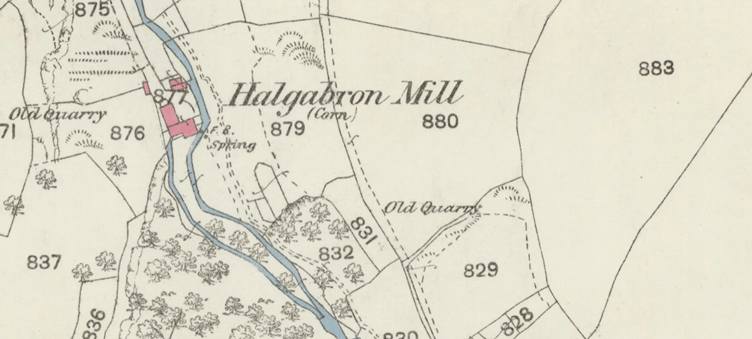
Pass a little footbridge and cross the second and third, as the path winds closer to the heart of the gorge, the river carving its path beside the valley walls which rise into dripping curtains of moss and fern. Follow the route as it guides you up and away from the water’s edge, climbing slate steps and tree roots. Gradually the valley drops down steeply to open up to St Nectan’s Kieve (kieve being the Cornish word for bowl). On reaching the Tree of Life Café, a ticket is required to visit the waterfall, the entrance then through the gift shop.


The Kieve is a deep, circular rock basin carved over thousands of years by the river forcing its way through a narrow cleft in the slate. The waterfall plunges down through a natural rock arch, a perfect window cut by water alone, and drops into the bowl below in a constant, spiralling fall. It is one of the most dramatic natural features in Cornwall, and for centuries it has drawn visitors who felt there was something otherworldly about this place.


The Kieve became widely known in the Victorian era, when artists and writers travelled here in search of wild, romantic scenery. Charles Dickens, William Thackeray, and the painter Daniel Maclise visited in 1842. But long before Victorian tourists arrived, the Kieve was regarded as a sacred site where the veil between worlds was thin. Offerings were left here, from coins to prayers, which continues today, with the rocks around the basin often decorated with tokens of remembrance or hope.


Woven through all of it is the legend of St Nectan, the 6th‑century hermit whose name has stuck to this valley for more than a thousand years. Tradition claims he lived in a small cell above the waterfall, choosing this hidden gorge for its solitude, its constant water, and its sense of being set apart from the everyday world. Travellers passing along the old routes between Tintagel and Boscastle were said to have found shelter here, welcomed by a quiet, gentle figure who offered food, prayer, and guidance. According to the oldest stories, Nectan kept a silver bell, which he rang in the mist to guide lost souls through the valley.


There was once a chapel here too, now lost, but remembered in early accounts. Some believed it stood close to the waterfall itself, perhaps on a ledge above the kieve, marking the site of the hermitage. Others place it further downstream, where the valley widens. Nothing of it survives now but the tradition of a sacred building here is strong enough that Victorian writers repeated it as fact, and local memory held onto it long after the stones were lost.


Some say Nectan did not live here alone but shared the valley with spirits of the water. They were guardian beings who protected the gorge and watched over the falls. Others speak of faeries glimpsed in the spray, or strange lights moving through the trees at dusk. These tales sit comfortably beside the Christian tradition, as if the valley has always been a meeting point of older magic and newer devotion.

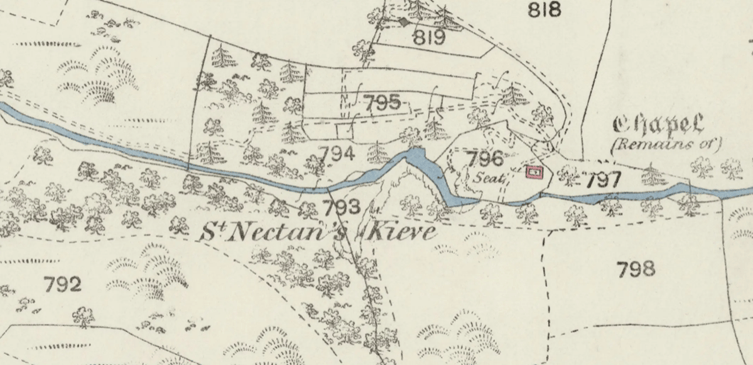
Take the steps out of the gorge to pass the front of the café and join a track. Climb gently up the hill and around to the right to the highest point on the walk. At the junction of tracks near the peak, turn left heading straight back down past St Piran’s Chapel into Trethevey. Retrace your steps to the road and turn left to arrive back at the car park and your vehicle.


